ZENITH G.F.J.: A Celebration of Horological Mastery at the Heart of Tradition
In the heart of Europe lies a city with over six centuries of history, renowned for its mineral springs, magnificent colonnades, and timeless elegance. Karlovy Vary. This spa town, surrounded by rocks, is a living embodiment of historical traditions. Here, Art de Suisse, a family-owned store with exceptional watches, proudly brings the world's oldest watch brands to discerning collectors. Among them, one name resonates with special significance: Zenith.
And today, this famous Swiss manufacture confirms its place at the zenith of watchmaking with the introduction of the G.F.J. model. These exceptional watches commemorate the 160th anniversary of the brand's founding. The G.F.J. watches are named after the visionary founder Georges Favre-Jacot and reintroduce the movement that shaped the very essence of precise watchmaking, the legendary caliber 135.
The Movement that Defined Precision
To understand the G.F.J. model, we must first highlight the significance of caliber 135. In the mid-20th century, long before the advent of digital measurement, the pinnacle of watchmaking was measured at chronometric competitions in observatories. Observatories could determine the accuracy of watches through precise observation of the Earth's axis rotation. In these rigorous tests, held at observatories such as those in Neuchâtel and Geneva, the precision of the best mechanical movements was tested. Winning such awards was not merely a badge of honor; it was an outright declaration of mastery.
Zenith participated in these trials as early as 1897 and quickly gained an excellent reputation, receiving a record 2333 chronometric awards. This is more than any other brand has ever achieved. At the center of this success was caliber 135, designed in 1949 by Ephrem Jobin. It was developed specifically for competitions and produced in two variants – a commercial version and the famous caliber 135-O, intended exclusively for competition in observatories.
This exceptional movement won first place five consecutive times from 1950 to 1954 at the Neuchâtel observatory, an achievement never before accomplished. The victories of the movements were confirmed by such renowned chronometrists as Charles Fleck and René Gygax. Its oversized balance wheel and off-center minute wheel made it a marvel of mechanical architecture and a watchmaking dream.
G.F.J.: Legacy Meets the Present
In 2022, Zenith briefly revived caliber 135-O in a collector's collaboration with master watchmaker Kari Voutilainen and auction house Phillips, sparking worldwide excitement. With the G.F.J. watches, Zenith now takes this revival of the caliber further, combining heritage with the most modern innovations.
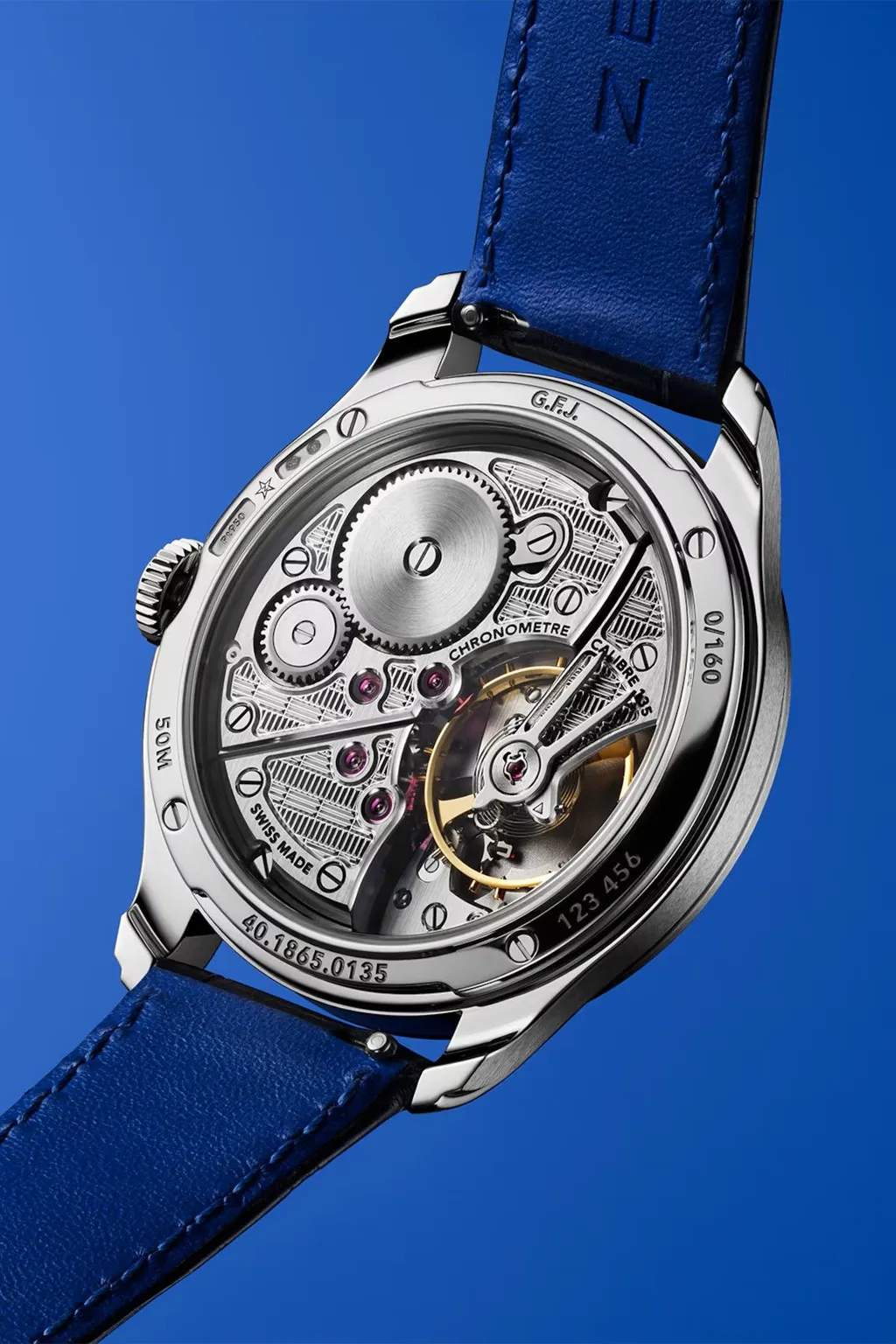
The movement housed in the G.F.J. watches retains the dimensions and layout of its historical predecessor, including the distinctive off-center arrangement and large balance wheel. However, it has been thoroughly modernized. The new caliber 135 now boasts a 72-hour power reserve, improved gear train efficiency, a Breguet hairspring, and hacking for precise time setting, features that were unthinkable in the 1950s.
Moreover, the movement holds a COSC certificate, confirming it measures time with a deviation of +/- 2 seconds per day. In the realm of mechanical time measurement, this is a stunning achievement.
The architecture of the caliber is as beautiful as it is functional. The bridges are adorned with a guilloché finish in a brick pattern, inspired by the red and white brick facade of the Zenith manufacture in Le Locle. The initials G.F.J., the founder of the manufacture, who realized his vision of uniting all watchmaking crafts under one roof, are still painted on it today. Every stone, gear, and surface has been finished to the highest standards, from the winding wheel hand-polished using the black-polishing method to the satin finish of the mainspring barrel.
An Ode to Timeless Design
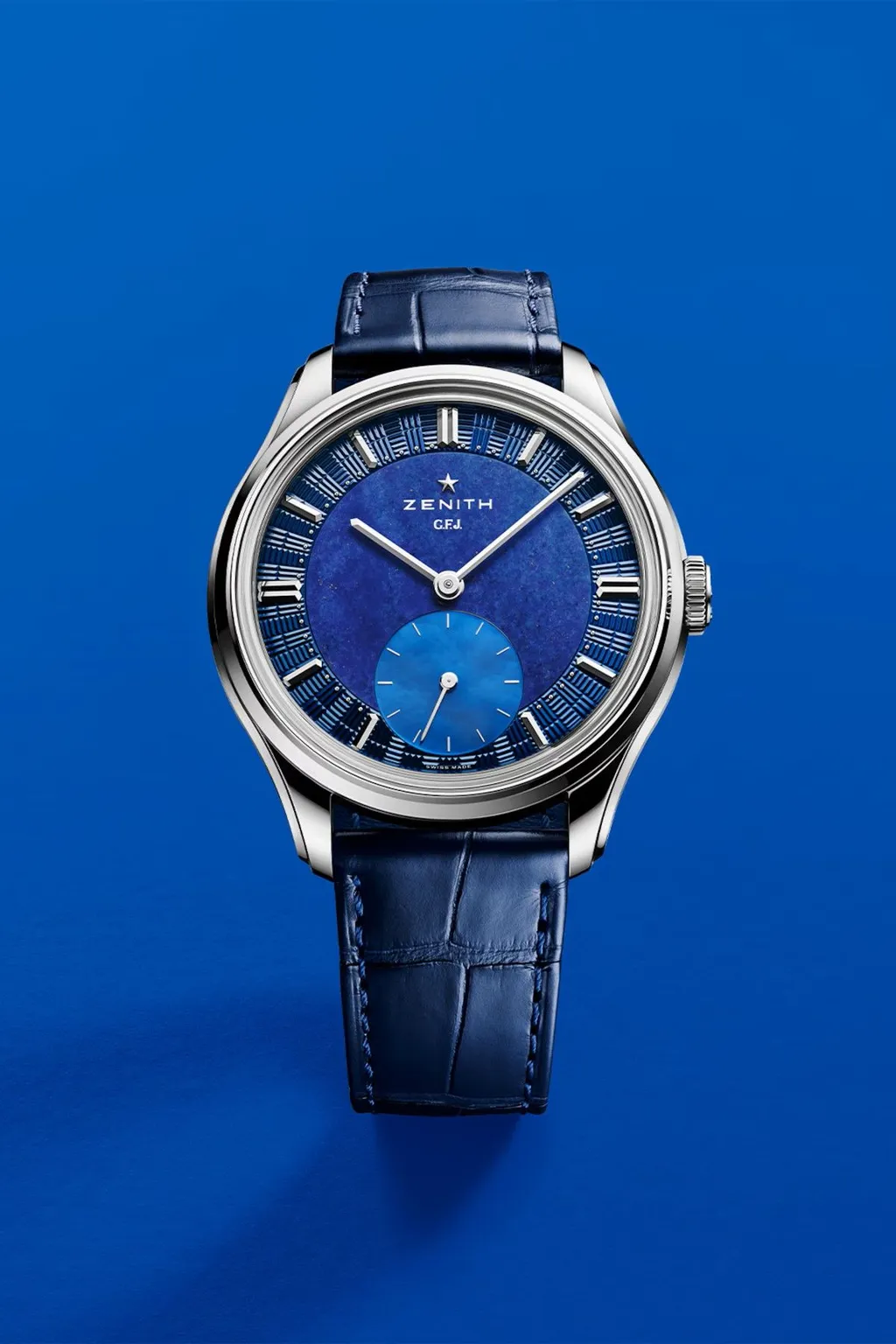
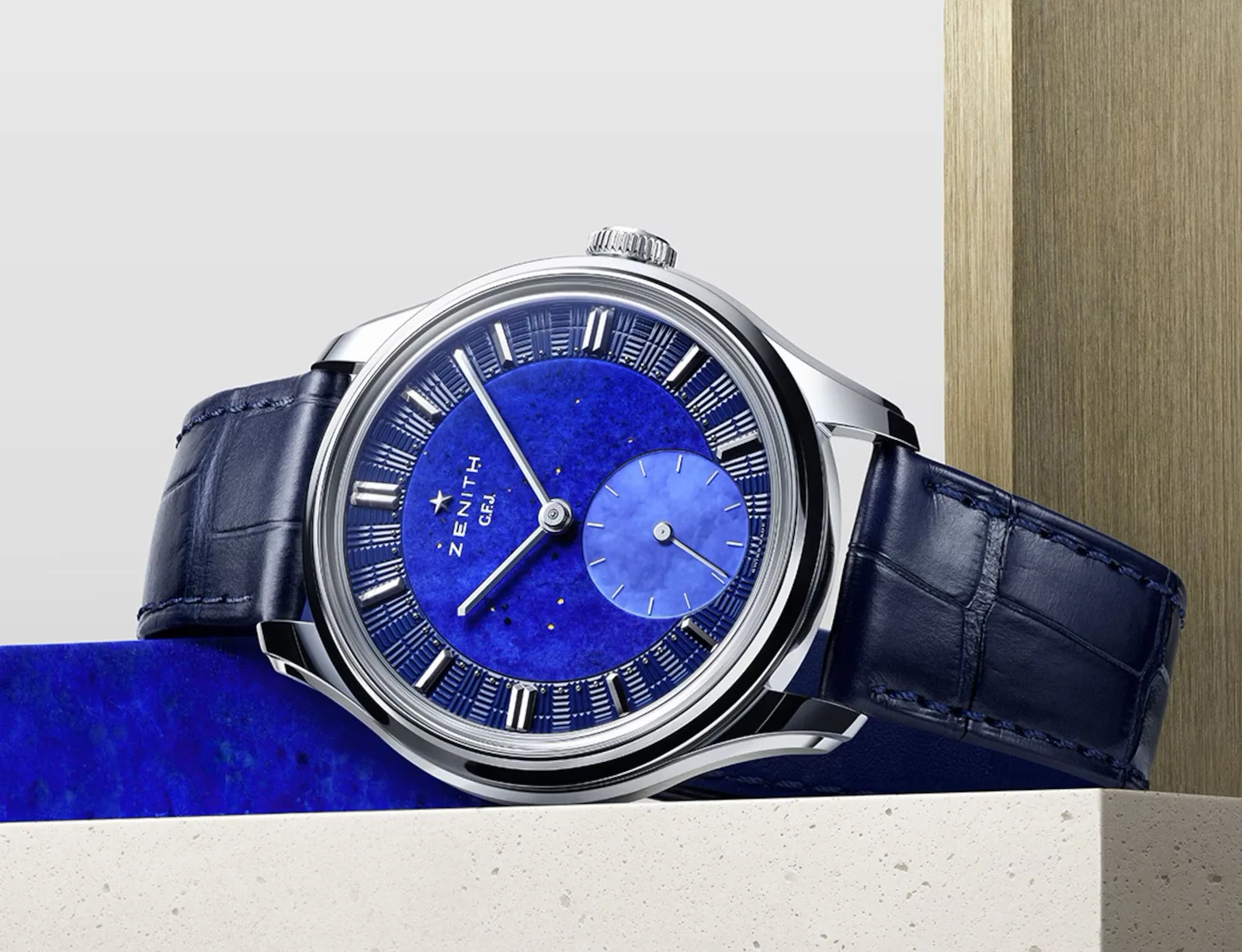
The G.F.J. watches themselves are the embodiment of elegance and balanced proportions. Their 39mm platinum case is slim and sculptural. The bezel profile is multi-stepped, and the lugs are slightly arched, both evoking the clean lines of 1950s design. Under the domed sapphire crystal lies a three-part dial with an unparalleled appearance. The design again uses the brick motif executed in guilloché, in the hour track where you will also find hour markers made of 18-carat white gold. The dark blue center of the dial is made of the semi-precious stone lapis lazuli. The natural grains of golden pyrite in the stone sparkle like distant stars, subtly referencing the celestial namesake of the Zenith brand.
The mother-of-pearl off-center seconds indicator is located at six o'clock, and the baton hands made of white gold elegantly sweep across the dial. Every detail is refined, thoughtful, and precise, whispering rather than shouting. The appearance of the watch remains true to the understated sophistication for which the Zenith brand is known.
To enhance their versatility, the G.F.J. watches come with three precisely crafted straps: one in dark blue alligator leather, another in black calfskin, and a third in blue saffiano leather. For collectors who prefer a cohesive metal aesthetic, a seven-row platinum bracelet is also available.
Zenith and Karlovy Vary: Places with a Sense of Legacy and Heritage
As one of the few cities in Europe that has preserved its historical core and craft traditions, Karlovy Vary offers not only picturesque scenery but also context. Just as the G.F.J. reflects Zenith's respect for its roots, Karlovy Vary represents the continuity of elegance across centuries. Both the watch brand and the city have evolved over time while remaining deeply rooted in the heritage of history.
This shared spirit of historical legacy and excellence draws Art de Suisse to represent brands like Zenith. As a family business, Art de Suisse understands the commitment to continuity in the form of passing down values, precision, and passion from one generation to the next. Whether it's the finely tuned stroke of a chronometer or the quiet ritual of winding a mechanical watch, Karlovy Vary and Zenith believe in the beauty of well-spent time.
In this city of mineral waters and neoclassical charm, Zenith watches are more than a status symbol. They are a legacy, a connection to the past, and a promise for the future.
A Tribute to Georges Favre-Jacot's Vision
The story of Zenith began in 1865 when Georges Favre-Jacot revolutionized Swiss watchmaking by bringing together under one roof all the disciplines needed to create a watch, including design, construction, finishing, and assembly. His manufacture in Le Locle, one of the cradles of horology, became the first vertically integrated watch factory in Switzerland. This bold vision allowed Zenith to create movements of unparalleled quality, including the legendary El Primero model and, of course, caliber 135.
The G.F.J. watches are more than just timepieces – they are a tribute to this pioneering philosophy. As Romain Marietta, CPO of Zenith, says: "It's about honoring this legacy while sharing it with a new generation of collectors." Every detail, from the movement's architecture to the dial's texture, reflects this balance between respect for the past and readiness for the future.
A Rare Opportunity
The G.F.J. watches were released in a limited edition of 160 pieces – one for each year since the brand's founding – and are available only in Zenith boutiques and authorized dealers. With their combination of technical achievements, historical significance, and artistic expression, they are destined to become a cornerstone of any serious watch collection.
Their rarity is matched only by their beauty and the timeless character of the city that hosts them. In Karlovy Vary, where centuries-old traditions meet modern luxury, the G.F.J. finds its perfect backdrop.
Art de Suisse: At Art de Suisse, we pride ourselves not only on selecting exceptional watches but also on delivering them with the personal care and attention that quality timepieces deserve. We are pleased to remind our readers and esteemed clients that we offer delivery of Zenith watches throughout the Czech Republic.
Gallery